

Rumah Penghulu Abu Seman
_svg.png)
JALAN STONOR,
KUALA LUMPUR
11 / 06 / 2023
AN INTRODUCTION
Rumah Penghulu Abu Seman is one of the heritage buildings that became an attraction for tourists. With breathtaking design and elaborated carvings, it is no wonder that this buiding serve not only as a tourist attraction, but also become study reference for students who’s interest in its construction. This Malay house belonged to Penghulu Abu Seman and is surrounded by traditional herbs and heritage garden which has over 50 species of trees and plants. This house is the perfect reference for the environmental, cultural and historic interest to Malaysians. Rumah Penghulu Abu Seman is located at 2, Jalan Stonor, Kuala Lumpur, 50450 Kuala Lumpur, Wilayah Persekutuan Kuala Lumpur.
HISTORY
Rumah Penghulu Abu Seman is the combination of architecture from Kedah, Perak, Thailand and China. The house was built between 1910 and 1930. The original owner of the house was Tok Taib who was a person of note in Kampung Paya Takong. After Tok Taib passed away, the house was sold to Penghulu Abu Seman bin Nayan who was the headman of Mukim Bagan Samak, Bandar Baharu, Kedah. In 1924, Rumah Penghulu Abu Seman was pull-apart and moved to kampung Sungai Kechil. When he died, the house was taken over by his son, Ibrahim bin Abu Seman. However, Penghulu Ibrahim had no son to inherited him, the family sold the house to Badan Warisan Malaysia in 1995. Rumah Penghulu Abu Seman was then moved to the heart of Kuala Lumpur by BWM in 1997.
Rumah Penghulu Abu Seman had been restoration from August 1996 until November 1997 to maintain the structural of the house. On August 8, 1996, the reconstruction of the tiang seri was carried out. The house was opened for visit in 1997. The travel agency also includes the house as a part of tour package in Kuala Lumpur. Rumah Penghulu Abu Seman won the international accolades by winning 2 UNESCO Asia-Pacific cultural heritage honor award in 2000 and the merit awards of Asian excellence award in 2003.
ARCHITECTURAL DESIGN
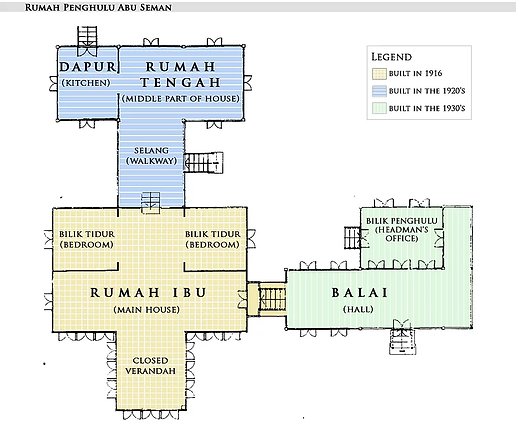
The construction process of Rumah Penghulu Abu Seman can be separated into three parts as shown as the figure above. Firstly, there are the main house, bedrooms and closed verandah which were built in 1916. Secondly, there is the middle part of the house and the kitchen which were built in the 1920’s. The last part is the hall which was built in the 1930’s.
For the first part of construction, Rumah Ibu is the largest area in the house where most activities are conducted while the bedrooms are for the wives of Penghulu Abu Seman. For better ventilation purposes, hanging curtains are used instead of doors for privacy purposes. According to Ali Alakhram, Verandah is the part which is connected to Rumah Ibu for relaxation purposes and seated work. It also functions as protection of the interior of the house from non-familiar visitors.
For the second part of construction, the kitchen is a part which is located at the back and lowest part of the house. Dining area which is near the kitchen is a place where the whole family have their meal together while sitting on a mat.
As for the last part, Balai is a working place for Penghulu Abu Seman and also the courthouse for their village at that period.

Exterior
Rumah Penghulu Abu Seman is a traditional Malay village house which is built above the ground with stilts. According to Debnath, the space below the house can be used for ventilation purposes and also as a place for storage. The raised ground level prevents flood and animals, catches winds of high velocity and provides privacy for the owner. The all-black exterior look of the house stands out against its green garden-like surroundings. Design of the main entrance of the house faces the direction of east west. In Malaysia which has hot weather, materials used to build this house should be lightweight with low thermal capacity. The reason to use this type of timber is to keep the house cold. There is a big house compound for the purpose of drying materials as well as a space for social interaction and work.

Roof
The type of roof used is gabled roof with an extended frame with ornaments on the edges of the roof. The rooftop is made of clay and elaborate carving symbolises the status of the penghulu. Large roof eaves function as effective sun shading and good protection against rain. The roof joint and panels allow sufficient ventilation purpose. The overhanged large roof and low window encourage good controlling glare in Rumah Penghulu Abu Seman and it is minimized by the wooden walls and natural ground covers of neighbouring houses based on the Case Study Malay Traditional House which was published in 2014 by Mohd Shazmie.
Carvings
Carvings can be seen in the interior and exterior of the house for example in the panel of window, door, wall, railing of veranda and gate. It marks the social and economic status of residents of homes. The function of carvings is to decorate the house, allowing sunlight to penetrate into the house and encourage air ventilation of the house. The types of carvings are flora, motifs of calligraphy, geometry and combination of different elements. These carvings in the house show the creativity of the craftsman and the degree of skillfulness of carving in the past.


Interior
According to the Case Study Malay Traditional House by Mohd Shazmie, a long house plan allows well circulation of air and good cross ventilation for the house. There are little partitions inside the house and the reason is to encourage good movement of air. With that, air can be circulated throughout the house.
Window
There are many windows in this house and the size of the windows are quite big. This is to encourage good ventilation and allow light to pass through it.

Staircase
Staircase is widely used to enable users to reach the elevated interior of the house. Stairs also connect the front land to the veranda.

Rumah Dapur
Rumah Penghulu Abu Seman can be divided into two areas which are rumah dapur and rumah ibu. For fire protection and safety purposes, rumah dapur is separated from the main house. Rumah dapur is a dining area where women work together for preparation of food. They will store their food and also dishes on a shelf which they call as para. The function of rumah dapur is the same with anjung where it was a place for women to have a rest and also a place for female guests to do house chores together with the host.


Rumah Ibu
Rumah Ibu is an area for seated work or relaxation purposes. Rumah Ibu preserves the privacy of the interior where non-familiar visitors would be entertained here, normally men will be nominated in this place. Rumah Ibu is with the conjunction respects the role of the mother as a housekeeper and family. Women are considered the most glorious people and should be respected.
SOCIAL & CULTURAL INFLUENCE
There are some cultural programs are carried out in Rumah Penghulu Abu Seman for children, youth and adults. The programs provide the experience for them to learn about the cultural, history, traditional and customs of the Malaysian lifestyle. Rumah Penghulu Children’s educational program allows children to learn about the architecture, history and tradition of the house. The children also learn about the language through this program. For youth, they know about the process of restoration and relocation of Rumah Penghulu Abu Seman. The person in charge of the program will explain how the house moved to the heat of Kuala Lumpur and the process of restoration from 1996 until 1997. Besides, the program about the customs and cultural of the house are provided for the adults. For example, the knowledge about the wedding, birth of child and the traditional food and beverages.

