
CHAN SHE SHU YUEN CLAN
_svg.png)
JALAN PETALING,
KUALA LUMPUR
AN INTRODUCTION
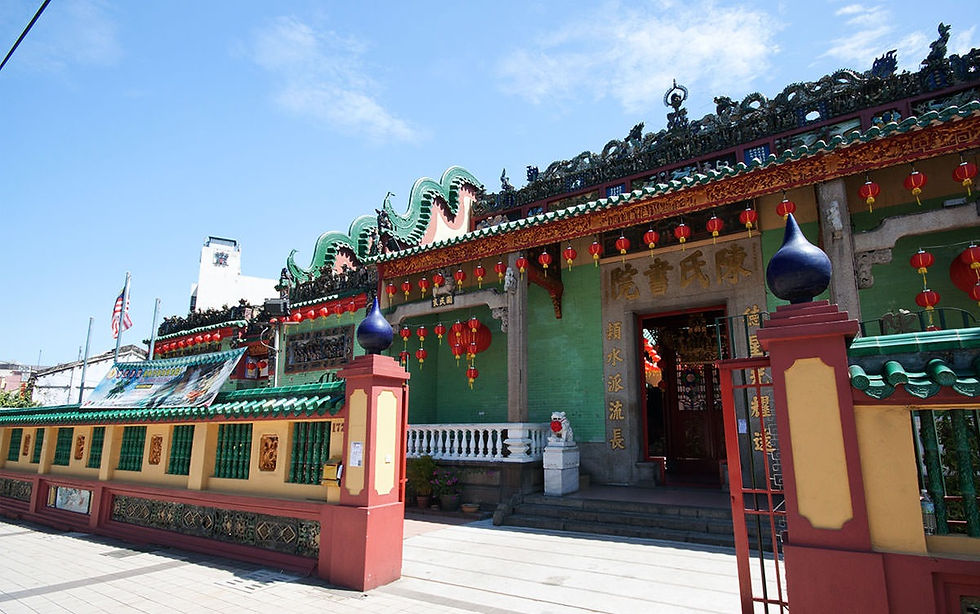
Chan She Shu Yuen Clan Association Kuala Lumpur & Selangor (CSSY) was founded as a Clan Consanguinity Organization in 1896 (during the Qing Dynasty Emperor Guangxu). This building is located strategically at the southern end of Jalan Petaling, fronting Chin Woo Hill and behind Klang River. The construction begin in 1897 and completed in the end of 1906. In September 2012, Chan She Shu Yuen have undergone refurbishment as this building had undergone 100 years of decay. The refurbishment was carried out to improve the existing structure looking forward for a new look while retaining the Chinese culture characteristics Government of Malaysia, through the National Cultural Heritage Act 2015, declared it as one of the historical cultural relics and a protected heritage building in 2016 due to its fine blend of Chinese culture and great artistic value.
HISTORY OF CHAN SHE SHU YUEN CLAN
The idea of establishment of Chen She Shu Yuen Association Kuala Lumpur & Selangor comes from Chen She Shu Yuen in Xiguan, Guangzhou. Honorable Chan Sow Lin which was a tin ore developer amazed by the beauty of Chan She Shu Yuen in Xiguan, Guangzhou when he was invited to visit the place. On 15th December 1897, British Colonial Government in Malaya land was intended to auction lands. Honorable Chan Sow Lin managed to tender seven (7) attached shop lots.
In order to solve Kuala Lumpur's overcrowded and housing crisis, the British Colonial Government has mandated completion of all vacant lands within one year. Upon having the property, Honorable Chan Sow Lin assigns someone to go to Xiguan, Guangzhou to investigate Chen Clan Ancestral Hall to get the buildings drawings. Honorable Chan Sow Lin employed the experts to downsizing the structure of Chen Clan Ancestral Hall in Xiguan, Guangzhou and created architecture and structural drawings that suit with the 7 lots he tendered.
To ensure the flow of construction progress is smooth, Honorable Chan Sow Lin managing the construction process together with Honorable Chin Choon and Honorable Chin Sin Hee. They employed the artists, architects and workers from Guangzhou to build up Chan She Shu Yuen KL that apply the Lingnan (Guangdong) style. All the building materials including tiles, roofs, sculpting materials, wood pillars and so on were imported from Guangzhou, whereas the stone pillars were manufactured in Malacca.
After ten years, finally the construction works were completed in the end of 1906. On 9 February 1906, the agreement was signed and sealed. The British resident of Selangor finally accepted the occupation; Sir Henry Conway Belfield (1902-1910) on behalf of the Sultan of Selangor; Sultan Alauddin. Sulaiman Shah Ibni Al-Marhum Yang Di-Pertuan Muda Musa (1898-1938) in 1908. The trust committee for Chan She Shu Yuen Clan Association was also set up to handle Chan She Shu Yuen on the same date.
The founders of Chan She Shu Yuan have same surname which is Chan. Chan She Shu Yuen initially is an association for those from ‘Chan’ clan. Families with same surname which can be either ‘Chan’, ‘Tan’ or ‘Chen’ belongs to this clan. Those with surname ‘Chan’ mostly come from Guangzhou, China. Chan She Shu Yuen was built as a Clan Consanguinity Organization. Consanguinity as we understand is a long form for “kinship” which in this case, of those from the “Chan clan”. In other words, the Clan association is a sort of “club” for those with the same surname – which in this case “Chan”, “Tan” and “Chen” that use the same Chinese characters.
During the rapid industrial growth of KL in 19th century, there is mass migration of China immigrants and various Clan associations were also established. Many descendants from the Chan clan have stayed in Kuala Lumpur and have contributed vastly here. The main purpose of establishing Chan She Shu Yuen was to provide shelter and security for the immigrants, particularly those from China's extended Chan clan who arrived in Malaysia by helping those newcomers adjust to this strange and novel country. The temple takes care of, and offers security for, the general welfare of immigrants. Now, Chan She Shu Yuen not solitary act as a historical connector with Kuala Lumpur likewise it also a place to worship those ancestors from Chen’s families.
Chan She Shu Yuen is one of the few survival clan houses in the city of Kuala Lumpur. Honorable Chan Sow Lin tendered these 7 lots because of her Chinese traditional belief towards Feng Shui which is a traditional practice commencing from ancient China, which harmonize individuals and their surrounding environment by using energy forces. The feng shui usually apply on architecture in terms of “invisible forces” that connect the universe, earth, and humanity together, known as qi.

ARCHITECTURAL DESIGN
Chan She Shu Yuen is built according to the architectural and the structural design of Chen Clan Ancestral Hall in Xi Guan, Guang Zhou, China. This antique building is a blend of ancestral hall and family temple incorporating magnificent pottery figurine, clay sculpture, wood and stone carving, painting and calligraphy, making Chan She Shu Yuen a rare piece of classical Lingnan building outside China.
Lingnan architecture also refer as Cantonese architecture. Normally Lingnan architecture will apply pale colors such as green and white and adopt various carvings and sculptures. Chan She Shu Yuen comprises of three carvings which are stone, wood and brick carvings and three sculptures which are ceramic, clay and colorful sculpture.
The designs will also apply large use of stone or brick as materials for walls. The highlighted feature is Wok Yi Uk (houses with wok handled roof) which is a special roof shape with two curved walls at both sides of the roof. Wok Yi Uk's purpose is to block sunlight's penetration into the inner space to make sure it's cool indoors.
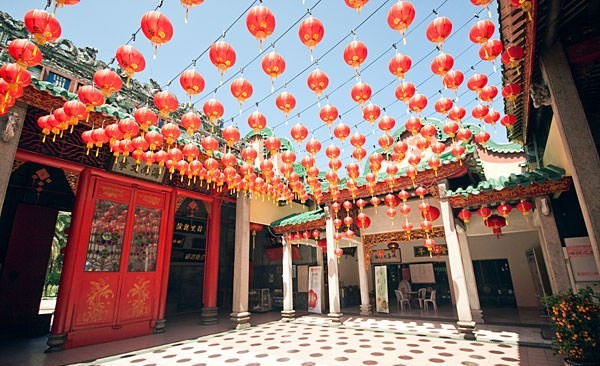
The features of Lingnan style included large use of open structures like courtyard, balconies and archways to provide natural ventilation. Chan She Shu Yuen have corridors, gable and a courtyard in front of middle hall to provide ventilation.
Guardian Lions are one of the features included in Lingnan architecture designs, the guardian lion in Lingnan architecture usually roaring, showing sharp teeth, and have bigger heads with a flat nose and smaller legs. Left side of the door normally will be male lions with one paw holding an embroidered ball while female will have a playful cub on its back which representing nurturing.


The whole structure is made of walls of brick, wood and stone. It adopts a two-inlet with a central symmetrical axis, and a top-view square. It consists of front and rear halls (Main Hall), vertical left and right wings, and glazed tile fence at the outermost. From far the gables on both sides of the roof are rolling and pastel. They are shaped like tiger heads and golden saddles.
The front and main halls together with left and right wing-rooms form a square courtyard which occupies the heart of the whole building, enabling connection between heaven/universe and earth. There are four square granite columns in front and at the back of the courtyard; each column is supported by three layers of square pads, signifying “Progressive Rise to Eminence”.

Roof

The two halls' roofs are lined with sculpted ridges. Along the roof were presented many beautiful and special potteries carving along with painted sculptures depicting various ancient Chinese drama characters, devas and mythological Chinese ethnic figures. It was believed that these dramas would be performing incessantly, so that there would be endless dramas for our ancestors to watch.
Main Entrance

On the top of the main entrance, there are four granite-carved characters of "Chen She Shu Yuen" encrusted with gold leaf. The gold leaf-laminated couplet guiding the entrance means “An everlasting flourish Chan/Chen consanguinity”. There are 2 bandstands on both the left and right sides of the main entrance, with drums and gongs being performed on the left bandstand and other traditional musical instruments being played on right to welcome guests during Chan She Shu Yuen’s celebration.
Middle Door

Right after the threshold of the main entrance to the front hall is a wood carved middle door, forming a layout of one door with two porch entrances. The wooden door is beautifully carved with “Kirin Delivering Child”, and above lies the multicolored glass with an inlay of four bats, meaning “Ushering in Abundance of Blessing”. Suspended from ceiling is a uniquely carved wooden sculpture depicting a story of “The Tour of Scholars”.
Column
A cylindrical column is erected respectively on the left and right sides of the door, and three layers of cylindrical cushions are placed underneath. A pair of parallel corridors, supported by four square columns, is on the left and right leading to main hall, these corridors are without main beam ridges. The first two columns feature a stone-carved carp facing downward, a symbol of fire protection in Feng Shui. The next two columns carry stone-carved bats carrying bronze coins in their mouths. As for the two wing rooms on left and right, they have been refurbished into air-conditioned offices and auditorium.
Main Hall
The main hall has three compartments, with The Core centralized in the hall and hung a plaque inscribing “De Xing Hall”. The memorial tablets of the late descendants of Chen and is decorated with gold leaf and wood carvings of fine workmanship. In front of the shrine are a table for offering, a blue pottery candle holder and an incense burner carved with Tao Tie, a, mythical, gluttonous and ferocious beast. The main hall has four big round columns with long couplets hung on each.
Walls

The main hall has three compartments, with The Core centralized in the hall and hung a plaque inscribing “De Xing Hall”. The memorial tablets of the late descendants of Chen and is decorated with gold leaf and wood carvings of fine workmanship. In front of the shrine are a table for offering, a blue pottery candle holder and an incense burner carved with Tao Tie, a, mythical, gluttonous and ferocious beast. The main hall has four big round columns with long couplets hung on each.
Pottery
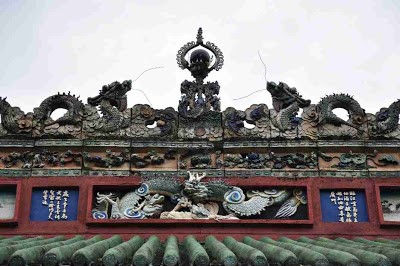
Amazing pottery located at ridge crest that fitted on the halls. Each pottery ridge crest applied theme that related with well-known traditional stories or dramas. Among them, there are some figures of characters in a play, or some may have included few scenes from those old times drama.
Plaster & Brick Carving

Plaster sculptures is a traditional architectural decorative element that widely used at Pearl River Delta. It mostly created in-situ according to the drawings and paint after the manufactured and sculptured plaster dried. The plaster carvings in the Chan She Shu Yuen located mostly on the bases of ridges and the roofs of corridors. Same as pottery, theme applied for plaster carvings in Chan She Shu Yuen are scenes in traditional dramas, birds and flowers. The plaster carvings in Chan She Shu Yuen were a good example of plaster art which these plaster arts are not limited by being a two-dimensional, but they will come in and out of the wall created a three-dimensional effect.
Each outer wall, inner wall and soffit of roof of great halls are hiding mystery which are brick carvings. There are poem that written with different fonts that exhibit the innovation and creativity of the artists. On the courtyard, there are also the combination of brick carve and poem applying themes of legend stories, historical stories and auspicious drawings with a believe that they will bring wealth and happiness to the member of the hall.

Ornaments
This temple was constructed using the materials and components which were imported from southern China. Its roof and gables tiled with pottery, as well as specially made ceramics depicting fantastic scenes. Few columns that support the temple show depictions of warriors fighting against lions and mythical creatures. The edges of the temple are blue ceramic vases while standing on either side of the main entrance are shrines to the female and male guardians of the doorway.
Chan She Shu Yuen ornamented and elegant Palace-alike architecture, displays the splendor art of the traditional Chinese glamour literature and history. The unique of Ling Nan architecture is the focus attraction of most visitors, researcher and scholars.
SOCIAL & CULTURAL INFLUENCES
Being an association that was formed under ancestral bloodline, Chan She Shu Yuen carried functions as a traditional clan house, as well as an ancestral hall. The annual ancestral worship ceremony and the Spring and Autumn season of ancestral worship in ancestral grave, had demonstrated the function of clansmen and the significance of culture of Chan She Shu Yuen.
For more than a century, the Chen’s descendants of CSSY had kept the tradition alive and uphold its core values generation after generation. Celebration and homage to the birth commemoration of Chen's Great Grand Ancestors, Spring and Autumn Festival Praying are Chen She Shu Yuen's principal occasion.
Chan She Shu Yuen puts great importance on public engagement. Cultural events such as the anniversary of Chan She Shu Yuen, the Lunar New Year, Duan Wu, the Lanterns Festival, the Winter Solstice Festival managed to assemble and unite people. In order to pass the traditional culture to the younger generation, all these activities need to be done regularly using various ways such as exhibitions, establishment of library or monument to ensure that these valuable cultural knowledge and moral values have not faded over time.


Chan She Shu Yuen plays a part in the preservation of Chinese culture in Malaysia. Chen She Shu Yuen authorities have arranged activities such as ancestral worship ceremony for the Chinese New Year, Lunar New Year Lantern Festival and Chinese New Year dinner. These activities are able to educate public that we were living in a multiracial country and thus promote mutual respect and understanding between each other.
For Lunar New Year Lantern Festival, public able to put up their name or their family names while donate to the temple. The high light of the event will be the donors could light up their lives and others with the mercy of Buddha with the lantern.
Chan She Shu Yuen also promote good value to the public by organizing blood donation activity to contribute to the society. CSSY also established a scholarship that can be applied by secondary students who have great achievements in their studies to encourage the importance of education.
