

MASJID JAMEK
_svg.png)
JALAN TUN PERAK,
KUALA LUMPUR
AN INTRODUCTION
Masjid Jamek is the oldest mosque in Kuala Lumpur which built in March 1908 and complete in December 1909, which also known as Friday Mosque. Standing on the Market Street bridge (Market Street is now known as Lebuh Pasar Besar), the bridge that spans the Klang River, one can enjoy a good view of the confluence of the Gombak River and the Klang River where Kuala Lumpur began as a mining settlement. It was at this very site where adventurers and miners in the late 19th century would land and unload their provisions and equipments. At the confluence, on a triangular piece of land, stands a 108-year-old mosque, the Jamek Mosque of Kuala Lumpur. The mosque is now dwarfed by the neighbouring modern skyscrapers and the adjacent LRT Train Station as it is situated at one of the busiest spots of the city but it still retains its charm, grace and elegance. The Jamek Mosque has been gazetted as the heritage building of Malaysia under Antiquities Act 1976 with the Gazette No. P.U. 423 on 13 October 1983.
HISTORY OF MASJID JAMEK

The graceful mosque was designed by Arthur Benison Hubback. He was an architect that works for Selangor public works department, he was also the one who designed Sultan Abdul Samad Building and Masjid Ubudiah. The Mugal and Moorish architecture style of Masjid Jamek is an iconic part in the city centre. Nowadays, Masjid Jamek become one of the top tourist attraction in Kuala Lumpur and always crowned with prayer and tourist. Moreover, the fountains and lush garden surrounding the mosque offer peaceful relaxing area in the middle of bustling downtown.
Masjid Jamek stands as a well-known sign in Malaysia’s cultural history. The area of Masjid Jamek has a unique phenomenon, which is the Muslims who work around, not only workers but also busy business people, they will take a break to carry out their prayer at each call. There have 5 calls per day, which are custom for Muslims to perform their prayer. They carry out sincerity their obligation as a Muslim. Every Friday, the surrounding of Masjid Jamek is packed with massive traffic due to the sincerely Muslims gathered to worship.
The Masjid Jamek site is previously a cemetery for residents nearby, the nearby place including Kampung Rawa which was the first village in Kuala Lumpur. This is proven by an article from The Star stating that they discovered gravestones that belongs to Muslims during early 1900s. Kampung Rawa and confluence of Klang River and Gombak river is also famous as it is where Kuala Lumpur was born, however in this case the story will focus on Masjid Jamek. The original buildings of Masjid Jamek can hold up to 400 worshippers at a time.
On 23 rd March 1908: Selangor Sultan, Sultan Sir Alauddin Sulaiman Shah laid the foundation stone and this mosque is officially opened on 23 rd December 1909. The overall total construction cost for Masjid Jamek was $87 000, the construction cost that Mohammedan community contributed for Masjid Jamek was up to RM32625, the rest is aided by the government.
The mosque has since been enlarged with extensions built, and the originally open-air forecourt roofed over. It has been bombed by Japanese on 26 September 1941, killing 3 worshippers and causing considerable damage to the building. One of the domes of the mosque collapsed in 1993 due to heavy rain, but has since been repaired
While on 23 rd June 2017, it is renamed to Masjid Jamek Sultan Abdul Samad (Sultan Abdul Samad Jamek Mosque) by Selangor’s Sultan Sharafuddin Idris Shah due to the mosque was originally built on land that was part of the state of Selangor. The location on the bank of the Klang and Gombak rivers and its surrounded palm trees provide a tranquil setting that complement the Masjid Jamek exquisite domed tower.
ARCHITECTURAL DESIGN
The Mosque, which has been built to the design of Mr. A.B Hubback, Architectural Assistant, P.W.D., is in the Arabesque style, and consists of the Mosque itself (with the meh rap facing towards Mecca), 40 ft. deep and 100 ft. wide, and a courtyard in front, 56 ft deep and 101 ft. wide. At the two corners of the court-yard furthest from the Mosque are two minarets, each 88 ft. high and identical in design, with a spiral staircase leading to two circular galleries before the top one is reached. An arched wall encloses the courtyard on three sides, the Mosque being on the fourth, and in each of the walls there is an entrance.
The inside of the courtyard is open, excepting in the centre where there is a bathing pool, and from it a flight of steps leads up to three double doors into the main building. These are the only doors, though there are windows with coloured glass the whole way round. The roof of the building opens into three domes, the centre one, which has clerestory with windows running around it, being 70 ft. in height. The materials used are brick with concrete castings and plaster, though the tree domes are made of timber covered with malthoid roofing, painted white, while the floor is paved with Doulton tiles, designed after the pattern of a Malay praying mat. The total cost of the building has been $ 87,000, and of this sum a portion was given by the Government, the rest being subscribed among Mahomedans themselves.
The bricks used at Masjid Jamek is red bricks that was produced from Brickfields. Brickfields was once famous for good quality of bricks, all the bricks in Masjid Jamek was coming from Brickfields. This shows that Masjid Jamek is indeed a product of local as the contractor of Masjid Jamek itself is local which is Towkay Ang Seng. Masjid Jamek imported Royal Doulton ceramic white tiles from Royal Doulton that was custom made for Masjid Jamek. This same goes to cast iron spiral staircase at minarets that was made by St. Pancras Ironworks Co. and imported from London.
The design of Masjid Jamek was inspired by the beauty and architecture of the Mughal traditional mosque and buildings in Northern India. In the book “The mosques and musollas”. the mosque was built with the use of load-bearing brick walls and columns with ceremonial flowery arches belying the heavy brick feel. The roof is mounted by three typically Mughal onion-shaped domes over the main prayer hall, the largest dome with 21.3 m high is located at the central and is flanked by two smaller ones. Originally, the main prayer hall was opened out to a walled ‘sahn’ or courtyard which initially was unroofed. However, as a sign of climate practically to cater the country’s heavy rainfall and the need for more prayer space, the forecourt was roofed over.
Masjid Jamek also shows the combination of ancient Moorish, Islam and Mughal architectural style. There also have two red and white striped minarets with 26.8 m high occupy two corners of the building. The influence from Moorish architecture is portrayed through the banding of the minarets. This designed pattern has been described as blood and bandage. These Moorish architectural styles are a lot more common in Cordoba, Spain.
Masjid Jamek might look complex from the exterior, but it is actually straightforward looking in the interior. According to “The mosques and musollas,” the rectangular plan concept of the prayer hall is punctuated by the three circular sets of columns, holding up the three domes, which also punctuates the saf prayer lines of worshippers.
Like other A.B. Hubback buildings, the interior walls including prayer hall are in plain white, there is not much ornamentation, leaving a simple pristine feel of this historic icon of Kuala Lumpur.

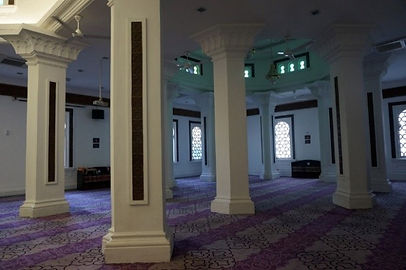
The mosque was built with the use of load-bearing brick walls and columns with ceremonial flowery arches belying the heavy brick feel.

The roof is mounted by three typically Mughal onion-shaped domes over the main prayer hall, the largest dome with 21.3 m high is located at the central and is flanked by two smaller ones.


Two red and white striped minarets with 26.8 m high occupy two corners of Masjid Jamek
SOCIAL & CULTURAL INFLUENCES
According to Sumarni , in the 1820s, a lot of Malays, majority Sumatrans crossed the Strait of Malacca to hike the thick jungle to explore their new life. They paddled along the Klang River and settled down at Petaling, it was 17km far from the city centre. Besides that, some Malays settled down at Kampung Haji Abdullah Hukum, which near Jalan Bangsar and 12km far from the city centre. They always head to the Klang-Gombak junction which closes to the place that Masjid Jamek is built to unload their food supplies after Kuala Lumpur is developed in the 1850s. Moreover, in the 1860s, Yah Ah Loy brought in many Malay farmers to provide food for the miner and settled near Kuala Lumpur (Yuen,). So, the Malay population increases continuously in Kuala Lumpur area. At that time, the Malays who are Muslims often congregate to worship in a small mosque. But, due to the road widen project, the mosque is forced to dismantle. Then, the Malay community decided to build a mosque that is large and can suit the growing population.
The Muslim house of prayers originates from the Arabic word ‘masjid’ which represents a place of prostration before God.
“Hence, it is also referred to as the House of Allah (Baitullah), a place where only Allah alone is worshipped and remembered as recorded (in Surah Al- Noor: 36 – the Holy Quran)”
According to ICNA ,for Muslim, the mosque is the most important building in Islam as it is considered as sacred ground in which communion between man and God is exchanged, and hence the aspects of prayers conducted in a mosque are seen as fundamental to a Muslim’s life. In Islam, worship is the very purpose of human existence. God declares in the Quran, the holy book of Islam, “I did not create … mankind except to worship Me” (51:56). Muslims worship God, the Creator and Sustainer of the universe, out of love and submission. They believe that He is the One God (Allah in Arabic) who is unique and only He deserves to be worshipped. In addition, a mosque is more than just a place of worship, the function of a mosque is also as the Muslim community development center.
Masjid Jamek stands as a well-known sign in Malaysia’s cultural history. The area of Masjid Jamek has a unique phenomenon, which is the Muslims who work around, not only workers but also busy business people, they will take a break to carry out their prayer at each call. There have 5 calls per day, which are custom for Muslims to perform their prayer. They carry out sincerity their obligation as a Muslim. Every Friday, the surrounding of Masjid Jamek is packed with massive traffic due to the sincerely Muslims gathered to worship.