

NATIONAL MOSQUE
_svg.png)
JALAN SULTAN HISHAMUDDIN,
KUALA LUMPUR
AN INTRODUCTION
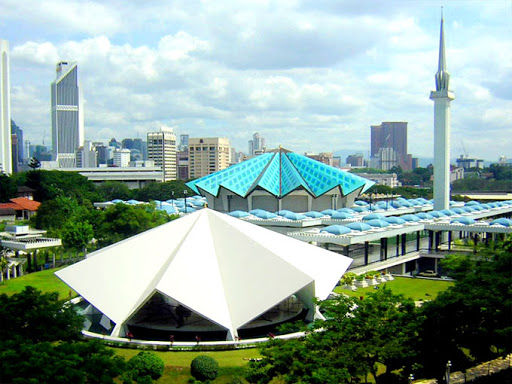
National Mosque is located in a strategic area of Kuala Lumpur. It near to old Malayan Railway Station, Earth Resource Building, Islamic Arts Museum, Post Malaysia, Kuala Lumpur Bird Park and Lake Gardens. The mosque was opened in 1965. It has a capacity for 15,000 people and is situated among 13 acres (53,000 m2) of gardens. It was designed by Malay origin, built by Chinese and Indian. The construction of the mosque symbolizes the spirit of Malaysian’s unity and tolerance due to the donation from Muslims, Buddhists, Hindus, Christians and others. Besides used as a praying place, National mosque used for various academic activities that include official ceremonies, public lectures, seminars, training workshops, conference, etc. There are many outdoor exhibition areas that can be used for exhibitions around the National Mosque without interrupting the praying process. The mosque also provides sports facility that can be used by its members to exercise.
HISTORY OF NATIONAL MOSQUE
National Mosque is built between 1963 and 1965, it is a national legacy. Malaya gained its independence from the British government on 31 August 1957. Major development programs in areas of economy, social and architecture were actively implemented in line with the new government. The programs were also to portray new progressive culture and achieved democracy. Therefore, on 30 July 1957, in the meeting of the Federal Executive Council an idea to build a national mosque a symbol of the country’s independence was mooted. In another meeting on 5 March 1958, Chief Ministers of the eleven states in the Federation of Malaya, a proposal was made to name the mosque Masjid Tunku Abdul Rahman Putra Al-Haj, in recognition of Prime Minister Tunku Abdul Rahman's efforts in guiding the country to gain the independence. However, Tunku refused this honour; on the contrary he named it Masjid Negara in thanksgiving for the country’s peaceful independence without bloodshed. On Friday, 27 August 1965, the mosque was declared open by the third Yang di-Pertuan Agong, the late Tuanku Syed Putra of Perlis.
Since the attainment of independence, Malaysia has become an increasingly important center for Islamic Religious activities. The primary southeast Asian regional conference of the World Muslim Congress was held in Malaysian capital in January 1964. Over 40 delegates from Burma, Ceylon, Thailand, the Philippines, Taiwan, Maldives Islands, Fiji, New Zealand, Brunei, and Malaysia attended the conference. The Congress President, His Eminence Syed Mohd. Amin El-Husseini Al-Haj himself was present. The conference decided to form Kuala Lumpur the headquarters of the Congress in this region for the dissemination of Islamic teachings. Besides, an international Koran Reading Competition is held within the capital each year in the fasting month of Ramadan. Leading Koran readers from several countries in Asia and the Middle East take part.
The Muslim College, the highest center of Islamic learning in this country of 11 million people, is situated only 20 miles from Kuala Lumpur. Given Kuala Lumpur’s growing importance as in Islamic center, it is appropriate that Malaysia should have a national mosque of sufficient grandeur, where future international Islamic conferences can be held. A special hall for this purpose has been incorporated in the mosque. The mosque underwent major renovations in 1987, and the once-pink concrete roof is now clad in green and blue tiles. Today, Masjid Negara continues to stand sleek and stylish against the Kuala Lumpur skyline.
THE ARCHITECTS
Dato' Baharuddin Abu Kassim

He is a Malaysian architect who has an education background of Architecture from University of Manchester. He worked for Public Works Department of Malaysia as assistant architect later to senior architect. He once worked with Jurubina Bertiga International Partnership (JBIP) and ATSA Architects Sdn Bhd. He was also an appointed consultant architect by Malaysian Government for high commission project in New Delhi, India and Islamabad.
A decision was made for Baharuddin Abu Kassim to lead the design team and carry on work until the completion of the building. Before planning and designing, he and other committee members had been sent to India, Pakistan, Turkey, Saudi Arabia, and other countries to conduct a few case studies of famous mosques in those counties. Furthermore, he applied his knowledge of mosque design from his study during his student’s years. Based on his design thesis during his studies at Victoria University of Manchester on a mosque for the state of Selangor, he proposed the functions of the mosque not only as a place of worship but also as a social activities center for the community. He believed a mosque should be a Muslim cultural center.
Dato' Dr. Ikmal Hisham Albakri

He is a Malaysian Architect who has an educational background of Architecture from Sheffield University. He became executive director of the Group of Architects Sdn Bhd. He also appointed as President.
Howard Ashley
He is a Scottish architect who has been practicing in Malaysia since 1952. He had worked for the Public Works Department of Malaysia for 11 years. He had been awarded the pan pacific award citation and received it for his significant contributions. National Mosque and Federal Building in Petaling Jaya are among the projects that he had involved.
ARCHITECTURAL DESIGN
Malay Traditional Architecture
National mosque was influenced by Malay traditional architecture. Datuk Baharuddin recalls being inspired by an umbrella accompanying royalty when stepping. The dome is built according to the design of umbrella. It is also named as ‘blue umbrella. When it is done constructed, Tunku Abdul Rahman Putra Al-Haj who is the First Prime Minister, is confused about the missing of dome. He was expecting a traditional semi-spherical dome. The dome is built in a shape of 18-point star, representing Malaysia 13 states and Islam 5 central Pillars. It is not built as conventional dome (semi-spherical dome). It is made from radial folded plate. It is hard to find a building with a design like this when the mosque is being designed. One of the architects, Datuk Baharuddin feels that it is a chance to build a roof with parasol shape and make it a unique mosque in Malaysia. The dome is designed based on the payung kertas idea which is come from Malay architecture’s ideas and motifs. The dome is built from concrete and is supported by 16 reinforced concrete pillars since there is only concrete available during that time.

Followed by the unique dome, the structure that being noticed is minaret with 73meter height. Minaret is also known as folded umbrella while the dome is known as opened umbrella. For mosque building, minaret is an obvious element and its function is to call for azan (call for prayer) by installing a loud speaker on the top of minaret to transfer the sound to a large area. Therefore, minaret as a landmark of mosque is an important element for National Mosque.
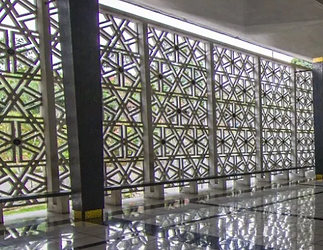
Malay traditional house has influenced the design of National Mosque. Since Malaysia is hot and humid all day, the air ventilation system is constructed based Malay traditional house (kampong house) which has elevated floor plan. During the old time, the house is elevated by pillars named as wakaf to avoid flood, animals attack and provide ventilation. The mosque is open in every corner with pillars everywhere. The prayer hall in Masjid Negara is located on the first floor just like in a kampong house with the structure that is elevated. The wall is not enclosed, but with geometrical shapes to ensure there is air flow. By this way, the maximum air ventilation is reached. By this way, there are always continuous air flow. The cold air can come inside and displace the hot air to decrease the temperature. Therefore, the visitors will not feel hot and impatient. Prayers can be done comfortably also.

Islamic Traditional Architecture
Based on Islamic Arts Museum Malaysia, there are 7 Islamic Architecture that representing the relationship of belief in Muslim and manifesting themselves in daily architecture. Architecture design of National Mosque is influenced by Islamic architecture 7 principles which are Tahwid, Dikr, Haya, Ikhlas, Iqtisad, Ilm and Ihtiram. Table below shows the principles with its descriptions.
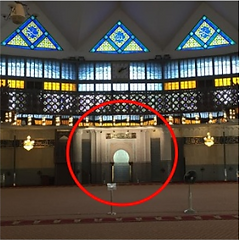
Tahwid means unity and uniquity of Allah where there is a same direction which is facing the ‘Qi-blah’ when prayers. It is the direction to ‘ka-bah’ in Mecca.

Dikr means remembrance of Allah where the mosque is surrounded by Quranic inscriptions.

Iqtisad means balance where the structure of the mosque is built symmetrically.

Ikhlas means sincerity which is achieved by physical action and belief in God which is prayer.
Ilm means knowledge where there is design which provide natural light into the mosque since knowledge is known as light of truth from Islamic view.

Haya means modesty where the mosque is covered partially which geometrical screening to create humility.

Ihtiram means respect where ‘Koran’ which is like a star is constructed to symbolize the universe middle.
Mausoleums
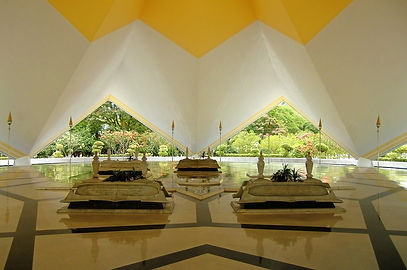
Mausoleum is a large, open, pavilion-like structures designed to create well-define space to shelter warrior’s tombs underneath it. This mausoleum was built in 1965, the architectural style is based on a combination of Islamic and Modernist Principles. It is one of the earliest post- Independence Modernist landmarks in Kuala Lumpur. Security for the tombs are provided as well, and for visitor and well-wishers who come to offer prayers is protected by the shelter.
Courtyard Garden

Building Structures

Columns

Walls
The walls are built from reinforced concrete and covered with the beautiful Italian marbles. The reinforced concrete is concrete in which wire mesh or steel bars are embedded to increase its tensile strength. Reinforced concrete is stronger than the normal concrete and it can withstand the weather in Malaysia.

Floor

Roof/Dome
The concrete dome was renovated in 1987 by overlaying the green and blue tile on the pink concrete which was inspired by the famous mosques in Pakistan, Saudi Arabia, Iran, Turkey, Spain and the United Arab Emirates. Beneath this big ‘umbrella’, it is the main prayer hall of this mosque. In the main prayer hall, there are triangular blue-stained glass panel with the Quranic which showed a similar technique of painting in Europe churches and cathedral.

Facade
The mosque shows no luxurious decorative elements at its facades. The four facades are made from plain white concrete walls with geometric concrete screen. It provides an additional layer between interior and exterior. It creates interesting light and shadows when the light is passing through the façade.

SOCIAL & CULTURAL INFLUENCE
This whole idea on building a mosque was created by Prime minister Tunku Abdul Rahman Putra Al-Haj during a Federal Executive Council meeting on July 30, 1957. This mosque stands proud in the heart of Kuala Lumpur. It was built due to commemorate Malaysia’s freedom from colonial rule and it symbolize the nation’s success in achieving independence without bloodshed. Dr Lai Chee Kien, an architectural lecturer from National University of Singapore notes that its brochure said “Masjid Negara designed by a Malay, constructed by Chinese and Indians and financed by contribution from Buddhist, Hindus, Christians and Muslims”. It shows how the national solidarity born through this project.
Masjid Negara build with a modern Islamic design which can give aspirations of a young and a growing nation. It remains as one of Malaysia’s most iconic structures. Through this structures, tourists and visitors able to read the symbolic of new Malaysia, view the image of development and modernity along with aspiration new nation. Throughout 56 years of the establishment of national mosque, various successes have been achieved. It gives positive feedbacks to the development from many aspects whether from Islamic development, systematic learning, materials for publication, as a centre for tourism and is viewed as a mosque of national status.